Showing posts with label Birds. Show all posts

Bird Glyph

Grades: 3-4

*This is a lesson I taught to third and fourth graders at six different elementary schools as part of an afterschool science program.

1. As a class, read and discuss the bird information sheet.

Scan_Pic0078

2. Have the students answer the questions on the worksheet. Have the students not only circle the box with the correct answer, but have them circle the box underneath the correct answer.

Scan_Pic0079

3. Have the students follow the directions in their circled box in order to color the birds sheet.

Scan_Pic0080

Penguin Glyph

Grades: 1-2

*This is a lesson I taught to first and second graders at six different elementary schools as part of an afterschool science program.

1. As a class, read and discuss the penguin information sheet.

Scan_Pic0075

2. Have the students answer the questions on the worksheet. Have the students not only circle the box with the correct answer, but have them circle the box underneath the correct answer.

Scan_Pic0076

3. Have the students follow the directions under the correct answer box in order to color the penguin.

Scan_Pic0077  


Bird Beak Buffet

Grades: 1-6

*This is a lesson I taught to first through sixth grade students as part of a weeklong science camp.

1. Use the “Fit the Bill” worksheet to discuss how different bird beaks designate the different bird diets.

Scan_Pic0043

2. Set up stations so that each one has a food to consume, two different types of tweezers/pliers, and two ‘stomachs’ (small plastic cups).

DSCN2683

2. Have students rotate through each station in partners. You will need different food items and different types of pliers/tweezers at each station.

DSCN2682

3. At each station, each partner will get a pair of tweezers or pliers. When time starts, each student will try to consume their food and put it into their stomachs. When time ends, each student will count how much of each food item they ate, discuss and compare with their partner, then record on their worksheet.

DSCN2684

4. Partners will rotate through each station, completing their worksheet at each station.

Scan_Pic0033

Scan_Pic0034

Bird Feeders

Grades: PreK-6

*This is a lesson I taught to first through sixth grade students as part of a weeklong science camp.

*I also taught this lesson to a group of preschool students.

1. After discussing the different types of beaks on birds, have the students make a pinecone bird feeder. Roll pinecones in peanut butter, then in bird seed.

DSCN2320

2. Have the students predict which type of birds will visit the feeder, which ones won’t, and why.

3. Hang the feeders outside and observe for a few weeks.

DSCN2322

Owl’s Feathers

Grades:1-6

*This is a lesson I taught to first through sixth grade students as part of a weeklong science camp.

1. Discuss how an owl can silently sneak up onto its prey.

2. To demonstrate how an owl’s flight is silent compared to other birds, spin two ropes (one shredded) through the air, one at a time, comparing the sound made by each.

DSCN2687

3. The rope that is shredded is silent, like the owl’s feathers. The shredded rope allows air to flow through it, not causing any air resistance like the normal rope, which will make a whistling noise.

Mapping Bird Migration

Grades: 1-6

*This is a lesson I taught to first through sixth grade students as part of a weeklong science camp.

1. Start by discussing reasons why and how birds migrate.

2. Give each group of students a picture of a bird and the areas from which the bird migrates to and from.

Scan_Pic0031

Scan_Pic0032

3. Have each group of students use a North and South America map to map where their bird migrates to and from (Integrating Geography). They can cut out the little picture of the bird and pin it to the marked migration route.

Bird Feet

Grades: 1-6

*This is a lesson I taught to first through sixth grade students as part of a weeklong science camp.

1. If possible, check out a bird feet set from the local museum, science center, or fish and game center. If not possible, then show pictures of bird feet.

2. Discuss the different types of bird feet and their different uses.

* (Make sure that you’ve completed the previous lesson about bird beaks).

3. Give each student a copy of the birds worksheet and a sheet of construction paper.
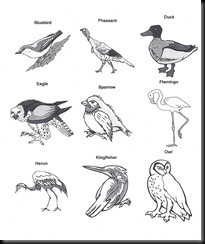
Scan_Pic0035Scan_Pic0044

4. Have the students cut out the birds and glue them onto the construction paper. Under each bird, have the students write down each birds probable habitat and diet according to their beak and feet.

5. As a wrap up to bird beaks, feet, habitat, and migration, have the students design their own bird using available art supplies (integrating art).

6. Have each student share with the class the following traits about their bird:
- beak: what the bird eats and where it lives
- feet: what the bird eats and where it lives
- feathers: where the bird camouflages best
- habitat: where the bird lives and if it migrates